G. K. Chesterton and Hilaire Belloc discussing Hitler and the Jews (1933-1937)
Some of G. K. Chesterton’s fervent defenders (especially those who would like to see him declared a saint) argue that he could never have been antisemitic because he was a staunch and early critic of Hitler. The argument that he could not have been antisemitic on the grounds that he criticised Hitler is weak and unsound. Interpreted in the very best light, it would only demonstrate that Chesterton, in the final years of his life, eventually overcame his anti-Jewish discourse. However, the evidence does not even support the conclusion that he overcome his antisemitic prejudice, for there is little to suggest that he actually altered or softened his opinions about Jews or the so-called “Jewish Problem” after Hitler rose to power in Germany. If anything, Chesterton considered his critiques of “Hitlerism” and Nazi antisemitism to be entirely consistent with his earlier deprecating stereotypes of the Jew and his proposed solutions to the Jewish Problem. As far as Chesterton was concerned, the rise of Hitlerism clarified the urgency of solving the so-called Jewish Problem. Significantly, he not only continued to maintain his antisemitic stereotypes of the Jew from 1933 onwards, he incorporated them into the very articles in which he condemned and criticised Hitlerism. So yes, he did say in an oft-quoted interview in 1933 that he was “quite ready to believe” that he and Belloc would “die defending the last Jew in Europe” (“Mr. G. K. Chesterton on Truculent Prussianism,” Jewish Chronicle, 22 September 1933, 14.) But then he also claimed in G.K.’s Weekly in July 1933 that “it is perfectly true that the Jews have been very powerful in Germany. It is only just to Hitler to say that they have been too powerful in Germany.” Chesterton argued that it will be very difficult for Hitler to persuade Germans to amputate the Jewish contributions to German culture, such as Heinrich Heine and Felix Mendelssohn. “But again,” he continued, “it is but just to Hitlerism to say that the Jews did infect Germany with a good many things less harmless than the lyrics of Heine or the melodies of Mendelssohn.” Chesterton went on to state that “it is true that many Jews toiled at that obscure conspiracy against Christendom, which some of them can never abandon; and sometimes it was marked not be obscurity but obscenity. It is true that they were financiers, or in other words usurers; it is true that they fattened on the worst forms of Capitalism; and it is inevitable that, on losing these advantages of Capitalism, they naturally took refuge in its other form, which is Communism” (G. K. Chesterton, “The Judaism of Hitler,” G.K.’s Weekly, 20 July 1933, 311).
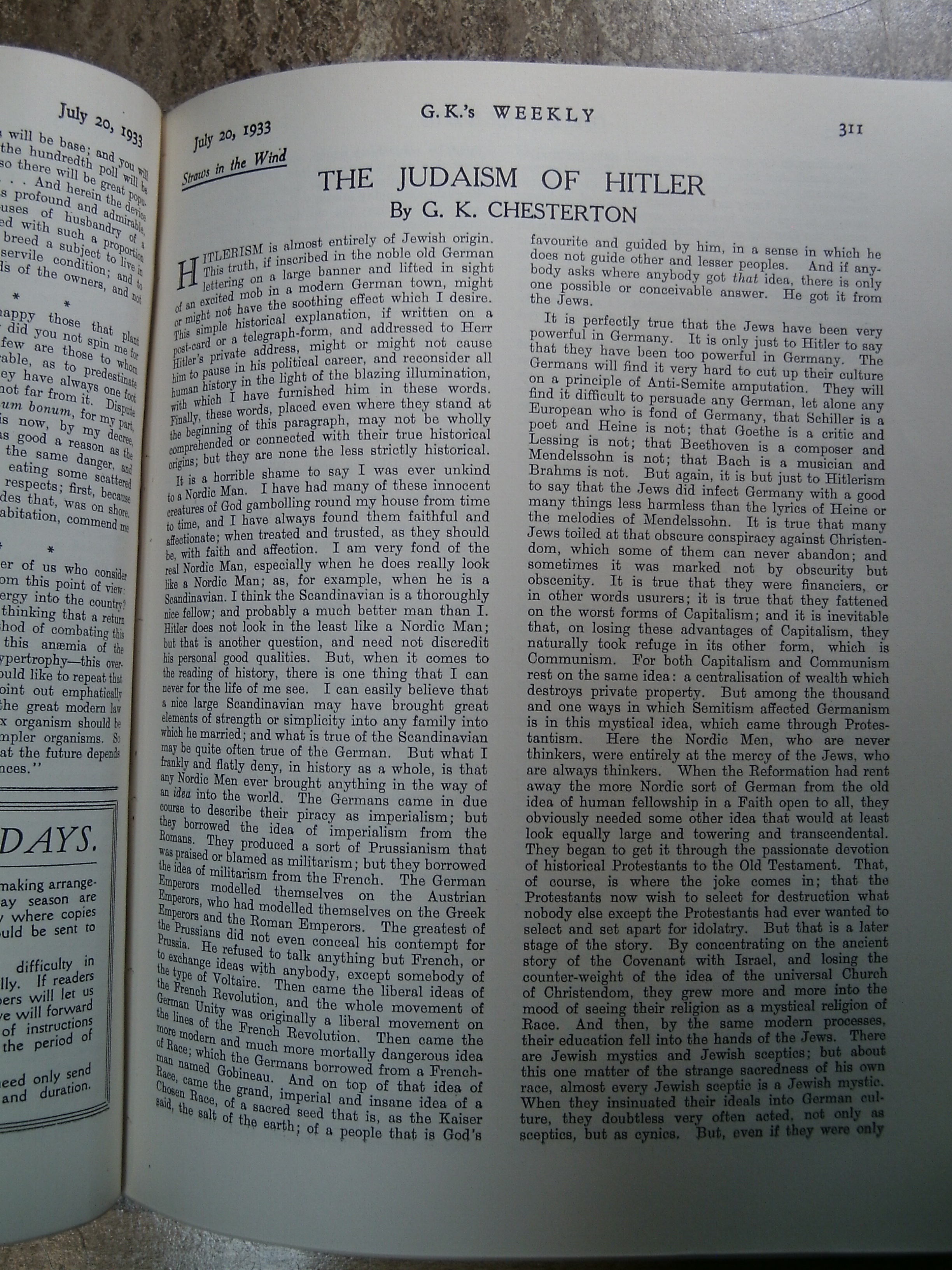
G. K. Chesterton, “The Judaism of Hitler,” G.K.’s Weekly, 20 July 1933.
.
Chesterton repeated the antisemitic stereotype of rich greedy Jews in other articles that were critical of Hitler. For example, in an essay entitled “On War Books,” he condemned “Herr Hitler and his group” for “beat[ing] and bully[ing] poor Jews in concentration camps,” but then he stated that “what is even worse, they do not beat or bully rich Jews who are at the head of big banking houses” (G. K. Chesterton, “On War Books,” G.K.’s Weekly, 10 October 1935, 28). Interestingly, a later version of this essay, published posthumously in a volume entitled The End of the Armistice in 1940, omits the entire sentence in which Chesterton lamented that rich banking Jews escaped the beating and bullying (G. K. Chesterton, “On War Books,” in The End of the Armistice, edited by Frank Sheed, London: Sheed & Ward, 1940, 192). Presumably the decision to remove the offensive sentence was made by Frank Sheed, the volume’s editor and publisher.
Chesterton repeated the stereotype of the pro-German Jew in his critique of Hitler. He asked, “was Hitler really so ignorant, that he did not know that the Jews were the prop of the Pro-German cause throughout the world?” (G. K. Chesterton, “A Very Present Help,” G.K.’s Weekly, 4 May 1933, 135). Chesterton criticised Hitler, and then repeated his claim that there is a Jewish Problem. He stated that “there is a Jewish problem; there is certainly a Jewish culture; and I am inclined to think that it really was too prevalent in Germany. For here we have the Hitlerites themselves, in plain words, saying they are a Chosen Race. Where could they have got that notion? Where could they even have got that phrase, except from the Jews?” (G. K. Chesterton, “A Queer Choice,” G.K.’s Weekly, 29 November 1934, 207).
Chesterton’s criticisms of Dreyfus and the Dreyfusards, which he often repeated throughout his journalistic career (link for G. K. Chesterton and the Dreyfus affair), were also repeated in his critiques of Hitler. He stated in March 1933 that when England “wanted to abuse France, where there is really very little real Anti-Semitism, we turned the world upside about the condemnation of one isolated individual Jewish officer, who had attained a high position of confidence, and who was charged, rightly or wrongly, with violating that confidence.” Chesterton combined criticising the Germans for persecuting Jews with repeating his earlier assertions that Dreyfus was probably a Germany spy. According to Chesterton, the English were never informed that “Dreyfus had got leave to go to Italy and used it to go to Germany; or that he was seen in German uniform at the German manoeuvres.” Chesterton criticised Hitler for persecuting ordinary Jews, and then observed that in the case of Dreyfus, the “particular Jew in France may or may not have been a traitor; but at least he was tried for being a traitor” (G. K. Chesterton, “The Horse and the Hedge,” G.K.’s Weekly, 30 March 1933, 55). As Julia Stapleton has rightly noted, it seems that it never occurred to Chesterton to question whether there was any truth in the highly dubious allegations that Dreyfus was seen “in German uniform at the German manoeuvres,” or whether the claims “were suspect and thus beyond the realms of responsible journalism” (Julia Stapleton, Christianity, Patriotism, and Nationhood: The England of G. K. Chesterton, Plymouth: Lexington Books, 2009).
Chesterton also sometimes defended Hitler as if he were a mere puppet or “tool”. In September 1934, he stated that “I may possibly cause some surprise, if I conclude the composite portrait by saying that in certain aspects, and under certain limitations, I do not believe that Hitler is altogether a bad fellow; and that he is almost certainly a much better fellow than the men who are going to use him.” Chesterton suggested that in the beginning “he did really intend to do something for the poor, and especially for the peasants.” If he “did not do enough for his better ideas, and later did much more for his worst ones,” Chesterton argued, then “the reason is quite simply that he is not the Dictator.” He concluded that Hitler’s puppeteer or “drill-sergeant” will “soon give him his marching orders again” (G. K. Chesterton, “The Tool,” G.K.’s Weekly, 6 September 1934, 8-9). He repeated this idea in March 1936, when Hitler ordered the occupation of the Rhineland in contravention of the Versailles treaty. Chesterton stated that: “I have always said that there were healthy elements in Hitlerism, and even in Hitler; indeed I rather suspect that Hitler is one of the healthy elements in Hitlerism.” Chesterton argued that Hitler was “a better man than the men around him or behind him” (G. K. Chesterton, “Why did he do it?”, G.K.’s Weekly, 26 March 1936, 18).
As previously mentioned, Chesterton did say in an interview in 1933, that he was “quite ready to believe” that he and his close friend Hilaire Belloc would “die defending the last Jew in Europe”. Like Chesterton, Belloc did criticise Nazism. Chesterton and Belloc were also both staunch critics of the eugenics movement – though Chesterton’s book on eugenics included caricatures of Jews (See G. K. Chesterton, Eugenics and Other Evils, London: Cassell and Company, 1922; “Hilaire Belloc and the Ministry of Health,” Catholic Federationist, September 1920, 6). However, also like Chesterton, Belloc’s defence of Jews was somewhat equivocal. In his third edition of The Jews published in 1937, Belloc framed the problem of the Nazi persecution of Jews as one primarily of efficacy in solving the so-called “Jewish Problem”. Belloc asked what effect Nazi policy would “have upon a solution of the Jewish question?” “Is it,” he asked, “an advance towards a just solution of that question or not?” He observed that “there is no doubt that the Nazi attack was sincere” and that “there is no doubt that in the eyes of its authors it was provoked by a situation which they thought intolerable.” But the “Nazi attack”, he concluded, could be “neither thorough nor final.” Belloc argued that “it is not immoral, to declare a new policy and to say, ‘we will in future regard Jews as citizens of a different class from those around them, their hosts.” However, he concluded that the attack was unjust because “when things of that kind are done, justice demands that the effect shall be gradual, and that the loser by any new regulation shall be compensated.” It seems however that the main point of contention for Belloc was not that the Nazi policy was unjust, but that it was a failed policy. “The Nazi attack upon such of the Jewish race as are subject to Berlin is,” Belloc concluded, “not thorough, not final, but incomplete, and I think soon to prove abortive.” According to Belloc, “the policy has missed its mark, on lower grounds: it has missed its mark, because it has not dared to be thorough and has not had the competence to be well thought out” (Hilaire Belloc, The Jews, third edition, London: Constable, 1937, xxxix- xliii).
At best these essays by G. K. Chesterton and Hilaire Belloc reveal an ambivalent sentiment about Jews (which is to say, thinly veiled antipathy towards Jews, combined with equivocal defences of them). They were more an attack on what Chesterton referred to as “truculent Prussianism”, and an equivocal criticism of Hitler, than a defence of Jews. And this was the period in which, according to his defenders, Chesterton’s discourse about Jews was at its most sympathetic.
For more about G. K. Chesterton’s antisemitism, see: Chesterton’s Jews: Stereotypes and Caricatures in the Literature and Journalism of G. K. Chesterton
“Ludicrous, surreal” defence of G. K. Chesterton
A few days ago, Michael Coren reported a so-called “ludicrous, surreal episode” [1]. The episode in question was a Twitter discussion about a claim made in one of his books that the Wiener Library defends G. K. Chesterton from the charge of antisemitism. From the language employed, one might imagine a particularly bitter exchange, for Coren uses phrases such as the following to describe – and presumably to deter – those who dare to criticise Chesterton: “monomania, wrapped in the last acceptable prejudice of anti-Catholicism,” “the fundamentalism of those so committed to damaging Chesterton’s reputation,” and “the most extreme, bizarre lengths to have their way” [1]. The ad hominem tactic of dismissing out of hand the critics of Chesterton as “anti-Catholic” is regrettable and unfounded (especially as the discussion in question focused on Chesterton and the Wiener Library and not Chesterton’s Catholicism). Speaking for myself, I harbour no hostility for Catholics or Catholicism, and my concerns about Chesterton end with his hostile stereotypes and caricatures (about Jews and other “Others”). If I harbour a prejudice it is – to use a phrase once used by Chesterton to describe the sentiments of Americans – “a prejudice against Anti-Semitism; a prejudice of Anti-Anti-Semitism” [2].
But back to the article. Coren points out that he devoted a chapter to the issue of Chesterton’s discourse about Jews, and that only “one brief passage concerned London’s Wiener Library, a small institution devoted to the study of the Holocaust and anti-Semitism.” He stated that: “I spent a morning there in 1985 and discussed my research with a librarian. He told me that Chesterton was never seriously anti-Semitic. ‘He was not an enemy, and when the real testing time came along he showed what side he was on.’” Coren then expresses his indignation that “a self-published writer in Britain” – a reference to my recent examination of Chesterton’s stereotyping in Chesterton’s Jews – “demanded a name, proof, a reference.” “Sorry, mate: no name, no proof, and it was, as I say, a quarter of a century ago,” Coren replies. [1]
If Coren had originally stated merely that he had discussed his research with “a librarian” and that this librarian had defended Chesterton, then this would indeed be a relative non-issue (though a source citation would still have been useful). However, in the New Statesman in 1986 he attributed the defence of Chesterton to “the Wiener Institute” [3]. And in his biography of Chesterton the statement in defence of Chesterton is attributed to “the Wiener Library” [4]. There is of course a world of difference between the personal sentiment of an unnamed librarian and the position of the Wiener Library. Interestingly, he now describes the Wiener Library as “a small institution,” whereas back in 1986 when he was citing the Wiener Library in defence of Chesterton, he described the Wiener Library as “the best monitors of anti-semitism in Britain” [3].
The real issue is not Coren’s book per se – as he acknowledges, there have been plenty of subsequent biographies of Chesterton, and “some of them, frankly, rather better” than his [1]. However, subsequent authors have taken Coren’s earlier claim that the Wiener Library defended Chesterton at face value, and have repeated it in books, articles and web sites. As Ben Barkow, the current director of the Wiener Library states, “numerous websites cite a made-up quotation by the Library stating that Chesterton was not antisemitic. Our efforts to have these false attributions removed have largely failed” [5]. As a result, the myth that the Wiener Library defends Chesterton from the charge of antisemitism has acquired currency, when according to Coren’s latest article, he only discussed his research with an unnamed librarian he once met there [1] [6].
Turning to Coren’s other main point, he observes that Chesterton was “an early anti-Nazi” [1]. Here Coren is on safer – which is not to say solid – ground, and many of Chesterton’s defenders make the same point. Chesterton was anti-Nazi and it would be unfair to equate his particular brand of anti-Jewish discourse with Nazi antisemitism. However, if we are going to be fair and balanced, we should also point out that often in the very same articles in which Chesterton criticised Nazi antisemitism, he also repeated the stereotypes and caricatures of Jews that he had maintained before the 1930s. His defence of Jews was therefore not without its equivocation. Let’s look at a few examples. In March 1933, he criticised Hitler’s antisemitism, but then repeated his old claim that the English were never allowed to hear that “Dreyfus had got leave to go to Italy and used it to go to Germany; or that he was seen in German uniform at the German manoeuvres” [7]. In July 1933, he criticised “Hitlerism”, but then observed that it was “only just to Hitler” to point out that the Jews “have been too powerful in Germany.” He stated that “it is but just to Hitlerism to say that the Jews did infect Germany with a good many things less harmless than the lyrics of Heine or the melodies of Mendelssohn. It is true that many Jews toiled at that obscure conspiracy against Christendom, which some of them can never abandon; and sometimes it was marked not be obscurity but obscenity. It is true that they were financiers, or in other words usurers; it is true that they fattened on the worst forms of Capitalism; and it is inevitable that, on losing these advantages of Capitalism, they naturally took refuge in its other form, which is Communism” [8]. In November 1934, he criticised “the Hitlerites”, but then stated that: “There is a Jewish problem; there is certainly a Jewish culture; and I am inclined to think that it really was too prevalent in Germany. For here we have the Hitlerites themselves, in plain words, saying they are a Chosen Race. Where could they have got that notion? Where could they even have got that phrase, except from the Jews?” [9]. (For more on Chesterton’s discourse about Hitler and the Jews, see G. K. Chesterton discussing Hitler and the Jews, 1933-1936).
Coren concludes that he would rather be in the “valley with Gilbert than the peak with his critics,” because according to Chesterton it is possible to see “only small things from the peak” [1]. If viewing Chesterton’s discourse from the valley means missing such “small” details as these, then I am happy to occupy “the peak with his critics.”
.
Notes for “Ludicrous, surreal” defence of G. K. Chesterton
1. Michael Coren, “‘Ludicrous, surreal episode’ against G. K. Chesterton returns,” The B.C. Catholic, 13 September 2013, http://bcc.rcav.org/opinion-and-editorial/3069-canonization-attempt-resurrects-anti-semitic-claim (downloaded 17 September 2013).
2. G. K. Chesterton, What I Saw in America (London: Hodder and Stoughton, 1922), 140-142.
3. Michael Coren, “Just bad friends,” review of G. K. Chesterton: A Biography, by Michael Ffinch, New Statesman, 8 August 1986, 30.
4. Michael Coren, Gilbert: The Man Who Was G. K. Chesterton (London: Jonathan Cape, 1989), 209-210.
5. Ben Barkow, “Director’s Letter,” Wiener Library News, Winter 2010, 2.
6. For an examination of this resilient myth, see Simon Mayers, “The resilient myth that the Wiener Library defends G. K. Chesterton from the charge of antisemitism,” 1 September 2013, https://simonmayers.com/2013/09/01/the-resilient-myth-that-the-wiener-library-defends-g-k-chesterton-from-the-charge-of-antisemitism/ (downloaded 17 September 2013).
7. G. K. Chesterton, “The Horse and the Hedge,” Straws in the Wind, G.K.’s Weekly, 30 March 1933, 55.
8. G. K. Chesterton, “The Judaism of Hitler,” Straws in the Wind, G.K.’s Weekly, 20 July 1933, 311-312.
9. G. K. Chesterton, “A Queer Choice,” Straws in the Wind, G.K.’s Weekly, 29 November 1934, 207.
Israel Zangwill and G. K. Chesterton: Were they friends?
In a previous report I examined the resilient myth that the Wiener Library defends G. K. Chesterton from the charge of antisemitism. In this posting I raise a more complex question: what was the relationship that existed between the prominent Anglo-Jewish author, Israel Zangwill, and G. K. Chesterton?
 Israel Zangwill (1864-1926)
Michael Coren stated in 1989 that Israel Zangwill was a friend of Chesterton, describing them as a “noted literary combination of the time.”[1] Joseph Pearce has likewise reported that Israel Zangwill was someone with whom Chesterton had “remained good friends from the early years of the century until Zangwill’s death in 1926.”[2] One of the pieces of evidence of a friendship, circumstantial at best, is a photograph of Chesterton and Zangwill walking side by side after leaving a parliamentary select committee about the censorship of stage plays on 24 September 1909. The photograph was originally used for the front cover of the Daily Mirror on 25 September 1909. As they were both prominent authors, it is hardly shocking that they would both attend and give evidence at such a gathering. The photograph probably demonstrates little beyond that they shared an interest in government censorship and that they left the meeting at the same time (there is simply no way to tell for sure). According to an entire issue of Gilbert Magazine (2008) that was dedicated to defending Chesterton from the charge of antisemitism, Zangwill and Chesterton “had respect and admiration for one another.”[3] The photograph of them leaving the select committee on censorship was used as the front cover of the issue of Gilbert Magazine.[4] It has also been used in a number of other books and periodicals about Chesterton.

Chesterton and Zangwill after a parliamentary select committee about the censorship of stage plays on 24 September 1909
Prior to 1915, Chesterton had on occasion referred to Zangwill in positive terms, describing him as a “great Jew,” “a very earnest thinker,” and the “nobler sort of Jew.”[5] Likewise, Zangwill wrote a letter in 1914 and another in January 1915 which together suggest that an amicable relationship may have existed for a time (possibly until 1916). In 1914, he wrote to apologise for not being able to attend a public debate with Chesterton and several other people about the veracity of miracles. The letter was friendly though somewhat equivocal in its expressed sympathy for Chesterton’s play.[6] On 25 November 1914, Chesterton was overcome by dizziness whilst presenting to students at Oxford. Later that day he collapsed at home. He was critically ill, and it was feared that he might not survive. Whilst he did not fully recover until Easter, his wife reported on 18 January 1915 that he was showing some signs of recovery.[7] On 19 January, Israel Zangwill wrote a letter to Frances Chesterton, in which he expressed his pleasure at hearing that her husband was on the mend.[8]
Whatever the nature of their relationship, it did not prevent Chesterton from accusing Zangwill in 1917 of being “Pro-German; or at any rate very insufficiently Pro-Ally.” He suggested that “Mr. Zangwill, then, is practically Pro-German, though he probably means at most to be Pro-Jew.”[9] Their so-called friendship also did not prevent Zangwill from describing Chesterton as an antisemite. In The War for the World (1916), Zangwill dismissed the New Witness as the magazine of a “band of Jew-baiters,” whose “anti-Semitism” is rooted in “rancour, ignorance, envy, and mediaeval prejudice.” He suggested that G. K. Chesterton provided the “intellectual side” of the movement, which was, he concluded, “not strong except in names.” He stated that “Mr. G. K. Chesterton has tried to give it some rational basis by the allegation that the Jew’s intellect is so disruptive and sceptical. The Jew is even capable, he says, of urging that in some other planet two and two may perhaps make five.” Zangwill stated that the “conductors” of The New Witness would “do better to call it The False Witness.”[10] In 1920, Zangwill stated: “Yet in Mr. Chesterton’s own organ, The New Witness – the change of whose name to The False Witness I have already recommended – the most paradoxical accusations against the Jew find Christian hospitality.”[11]
In February 1921, in a letter to the editor of the Spectator, Zangwill described the proposal by Chesterton’s close friend, Hilaire Belloc, that Jews living in Great Britain should be characterised as a separate nationality, with special “disabilities and privileges,” as “ridiculously retrograde.”[12] Zangwill criticised Belloc’s scheme of “re-established Ghettos” in other articles, letters and notes in 1922. [13] Zangwill also observed in his letter to the Spectator, quite correctly, that Belloc’s “fellow-fantast, Mr. Chesterton, would revive the Jewish badge and have English Jews dressed as Arabs.”[12] This was a reference to a proposal by G. K. Chesterton in 1913 and again in 1920 that the Jews of England should be required to wear distinctive dress (he suggested the robes of an Arab).[14] According to Chesterton:
“But let there be one single-clause bill; one simple and sweeping law about Jews, and no other. Be it enacted, by the King’s Most Excellent Majesty, by and with the advice of the Lords Spiritual and Temporal and the Commons in Parliament assembled, that every Jew must be dressed like an Arab. Let him sit on the Woolsack, but let him sit there dressed as an Arab. Let him preach in St. Paul’s Cathedral, but let him preach there dressed as an Arab. It is not my point at present to dwell on the pleasing if flippant fancy of how much this would transform the political scene; of the dapper figure of Sir Herbert Samuel swathed as a Bedouin, or Sir Alfred Mond gaining a yet greater grandeur from the gorgeous and trailing robes of the East. If my image is quaint my intention is quite serious; and the point of it is not personal to any particular Jew. The point applies to any Jew, and to our own recovery of healthier relations with him. The point is that we should know where we are; and he would know where he is, which is in a foreign land.”[15]
Whilst these letters and articles do not disprove the argument that Zangwill and Chesterton had an amicable relationship, at least for a time, they do suggest that Zangwill did not believe that Chesterton was guiltless of antisemitism. If Zangwill considered Chesterton a friend after 1915, let alone a pro-Jewish friend, he had a strange way of showing it. At the very least they problematize the argument that Chesterton could not have been antisemitic on the grounds that Zangwill was his friend, as from 1916 onwards Zangwill clearly came to perceive and describe Chesterton as an antisemite.
I would love to hear from anyone that has found any other evidence of a friendship or enmity between Zangwill and Chesterton (please click here to contact me).
Notes for the claim that Chesterton and the Anglo Jewish author Israel Zangwill were friends
[2] Joseph Pearce, Wisdom and Innocence: A Life of G. K. Chesterton (London: Hodder and Stoughton, 1996), p.446.
[3] Sean P. Dailey, “Tremendous Trifles,” Gilbert Magazine 12, no. 2&3 (November/December 2008), p.4. Gilbert Magazine is the periodical of the American Chesterton Society.
[5] See G. K. Chesterton, Appreciations and Criticisms of the Works of Charles Dickens (London: J. M. Dent & Sons, 1911), xi; Letter from G. K. Chesterton to the Editor, Jewish Chronicle, 16 June 1911, p.39; G. K. Chesterton, Our Notebook, Illustrated London News, 28 February 1914, p.322.
[6] According to Zangwill, Chesterton was “putting back the clock of philosophy even while he [was] putting forward the clock of drama. My satisfaction with the success of his play would thus be marred were it not that people enjoy it without understanding what Mr. Chesterton is driving at.” The letter is cited in G. K. Chesterton, Joseph McCabe, Hilaire Belloc, et al., Do Miracles Happen? (London: Christian Commonwealth, [1914]), p.23. The letter is also quoted by Joseph Pearce in Wisdom and Innocence: A Life of G. K. Chesterton (London: Hodder and Stoughton, 1996), p.205.
[7] See Joseph Pearce, Wisdom and Innocence: A Life of G. K. Chesterton (London: Hodder and Stoughton, 1996), pp.213-220 and Dudley Barker, G. K. Chesterton: A Biography (London: Constable, 1973), pp.226-230.
[8] Letter from Israel Zangwill to Frances Chesterton, 19 January 1915, ADD MS 73454, fol. 44, G. K. Chesterton Papers, British Library, London.
[9] G. K. Chesterton, “Mr. Zangwill on Patriotism,” At the Sign of the World’s End, New Witness, 18 October 1917, pp.586-587.
[11] Israel Zangwill, “The Jewish Bogey (July 1920),” in Maurice Simon, ed., Speeches, Articles and Letters of Israel Zangwill (London: Soncino Press, 1937), p.103.
[12] Letter from Israel Zangwill to the Editor, “Problems of Zionism,” Spectator, 26 February 1921, p.263. In this letter, he went on to state that the so-called Jewish problem does “not concern Mr. Belloc, and I would respectfully suggest to him to mind his own business.” See also “Mr. Zangwill and Zionism,” Jewish Guardian, 4 March 1921, p.1.
[13] In May 1922, Zangwill referred to Belloc on a couple of occasions whilst criticising a non-territorial “spiritual” Zionism. He stated in the Jewish Guardian that “what the victims of anti-Semitism (the unassorted or downtrodden of our race) require is not a spiritual Zion, which ‘is no more a solution of the Jewish problem than Mr. Belloc’s fantastic scheme of re-established ghettos,’ but a ‘solid, surveyable territory.’” See “The Degradation of Zionism,” Jewish Guardian, 12 May 1922, p.8. He made similar remarks in a letter to the editor of the Times newspaper on 8 May 1922. He also wrote twenty-five pages of unpublished notes and criticisms of Belloc’s book, The Jews (1922).
G. K. Chesterton and the Dreyfus Affair
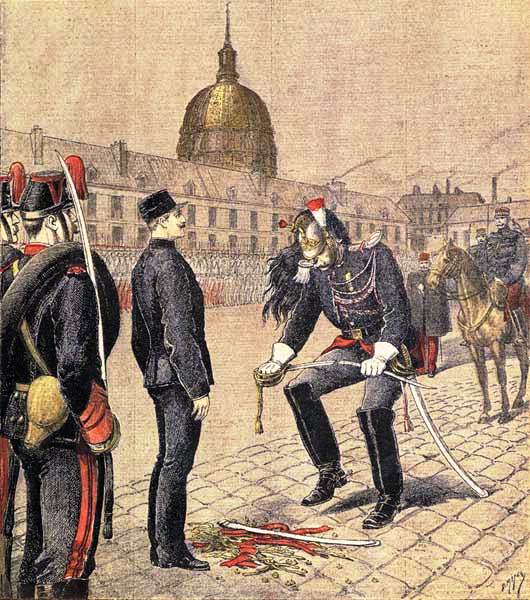
In 1899, Chesterton wrote a poem entitled “To a Certain Nation” as a reproach to France for the injustice done to Captain Dreyfus.[1] However, Chesterton soon reversed his opinion. In 1906, Chesterton added a note to the second edition of The Wild Knight which reveals that by 1906 he had started to change his position about where the greater injustice lay. The note stated that whilst “there may have been a fog of injustice in the French courts; I know that there was a fog of injustice in the English newspapers.” According to the note, he was unable to reach a “proper verdict on the individual,” which he largely attributed to the “acrid and irrational unanimity of the English Press.”[2] Chesterton maintained this antipathy about Dreyfus throughout his life. In letters to The Nation in 1911, Chesterton referred to the Jew “who is a traitor in France and a tyrant in England,” and stated that in “the case of Dreyfus,” he was quite certain that “the British public was systematically and despotically duped by some power – and I naturally wonder what power.”[3] He argued in 1928 that Dreyfus may or may not have been innocent, but that the greater crime was not how he had been treated at trial but how the English newspapers buried the evidence against him. According to Chesterton, “the English newspapers incessantly repeated that there was no evidence against Captain Dreyfus. They then cut out of the reports the evidence that he had been seen in German uniform at the German manoeuvres; or that he had obtained a passport for Italy and then gone to Germany.” Chesterton stated that when he discovered this, “something broke inside my British serenity; and a page of print has never been the same to me again.”[4] In another article Chesterton did defend a Jew, Oscar Slater, from the charge of murder, thereby demonstrating that Chesterton was not unremittingly antisemitic. However, seemingly unwilling to defend one Jew without sniping at another, he again repeated the accusation that the English newspapers left out “evidence that Dreyfus had appeared in German uniform at the German manoeuvres”[5] In another article, this time published in 1933, he criticised Hitler and Nazi antisemitism (something he did on a number of occasions as his defenders have pointed out), whilst yet again asserting that the English “were never told, for instance, that Dreyfus had got leave to go to Italy and used it to go to Germany; or that he was seen in German uniform at the German manoeuvres.”[6]
Chesterton’s unfavourable presentation of Captain Dreyfus can also be seen in one of his fictional works: “the Duel of Dr. Hirsch.” In this Father Brown short story, originally published in 1914, the Jew, Dr. Hirsch/Colonel Dubosc, is modelled on a diabolic composite of Judas Iscariot, Captain Dreyfus, Dr. Jekyll and Mr. Hyde. The Jew in the story sets up a second Dreyfus affair using false evidence, playing simultaneously the role of the accused villain (Hirsch) and the accusing hero (Dubosc). Hirsch succeeds in his complex scheme to be vilified as a traitor who has given military secrets to the Germans (the accuser being his own alter-ego), and then vindicated and heralded as a hero (whilst his alter-ego slinks away). Bryan Cheyette observes that Father Brown – a reoccurring hero in many of Chesterton’s short stories, who, as Dale Ahlquist has observed, reflects “Chesterton’s own moral reasoning” – “admits to being morally confused over whether Hirsch is guilty and compares it with his ‘puzzle’ over the ‘Dreyfus case.’” [7]
At the end of “the Duel of Dr. Hirsch,” the Jewish villain is seen by Father Brown’s assistant (M. Hercule Flambeau), half way through his metamorphosis from Colonel Dubosc to Dr. Hirsch. According to the narrator of the story, Hirsch’s face, with its “framework of rank red hair,” looked like “Judas laughing horribly and surrounded by capering flames of hell.” This final image of Hirsch is reminiscent of the so-called “diabolist” that Chesterton claimed he once knew, with “long, ironical face … and red hair,” and when seen in the light of the bonfire, “his long chin and high cheek-bones were lit up infernally from underneath; so that he looked like a fiend staring down into the flaming pit.”[8]
In conclusion, it does seem, on the surface, that the Dreyfus Case was a significant turning-point in Chesterton’s discourse about Jews (from sympathetic in 1899 to hostile by 1906). He claimed in 1928 that the Dreyfus Case marked “a great date in [his] life.” He stated that: “it was the last time I was deceived. Up to the time of the Dreyfus Case, I had believed like a child, or like a great mass of the public, that our press merely recorded what really happened; that no journalist but a chance criminal would suppress a vital fact.” It thus seems, as Julia Stapleton has rightly noted, that it never occurred to Chesterton to question whether there was any truth in the highly dubious allegations that Dreyfus was seen “in German uniform at the German manoeuvres,” or whether the claims “were suspect and thus beyond the realms of responsible journalism.” [9]
.
Notes for G. K. Chesterton and the Dreyfus Affair
[4] G. K. Chesterton, “Dreyfus and Dead Illusions,” Straws in the Wind, G.K.’s Weekly, 25 February 1928, 993.
[5] G. K. Chesterton, “In Defence of a Jew,” Straws in the Wind, G.K.’s Weekly, 27 August 1927, 575.
[6] G. K. Chesterton, “The Horse and the Hedge,” Straws in the Wind, G.K.’s Weekly, 30 March 1933, 55.
[7] G. K. Chesterton, “The Duel of Dr. Hirsch,” in G. K. Chesterton, The Complete Father Brown Stories (London: Wordsworth Classics, 2006), 213-224; Bryan Cheyette, Constructions of “the Jew” in English Literature and Society: Racial Representations, 1875-1945 (Cambridge: Cambridge University Press, 1993), 192-193; Dale Ahlquist, G. K. Chesterton: The Apostle of Common Sense (San Francisco: Ignatius Press, 2003), 166.
[8] G. K. Chesterton, “The Duel of Dr. Hirsch,” 224; G. K. Chesterton, “The Diabolist,” Daily News, 9 November 1907, 6.
[9] G. K. Chesterton, “Dreyfus and Dead Illusions,” Straws in the Wind, G.K.’s Weekly, 25 February 1928, 993; Julia Stapleton, Christianity, Patriotism, and Nationhood: The England of G. K. Chesterton (Plymouth: Lexington Books, 2009), 46.
The resilient myth that the Wiener Library defends G. K. Chesterton from the charge of antisemitism
A popular defence of G. K. Chesterton is that he could not have been an antisemite because the Wiener Library, one of the UK’s key institutes dedicated to researching antisemitism and the Holocaust, has defended him from the charge. Michael Coren instituted this defence in The New Statesman in 1986. He stated that the “Wiener Institute, the best monitors of anti-semitism in Britain, does not regard Chesterton as a culprit.”[1] Three years later, Coren attributed the following statement to the Wiener Library:
“The difference between social and philosophical anti-semitism is something which is not fully understood. … With Chesterton we’ve never thought of a man who was seriously anti-semitic on either count. He was a man who played along, and for that he must pay a price; he has, and has the public reputation of anti-semitism. He was not an enemy, and when the real testing time came along he showed what side he was on.”[2]
Coren did not provide a source for this alleged statement so it is not clear whether it was intended as an official or unofficial position of the Library. The Wiener Library informed me that “since the name of the person is not given, we can only suppose it to be an invention or else someone who was not entitled to talk, officially or unofficially, on the Library’s behalf.”[3]
Ben Barkow, the director of the Wiener Library, reported in 2010 that “numerous websites cite a made-up quotation by the Library stating that Chesterton was not antisemitic. Our efforts to have these false attributions removed have largely failed.”[4] The same issue of the Wiener Library News contained a short report (by the present author) on this Wiener Library Defence.[5]
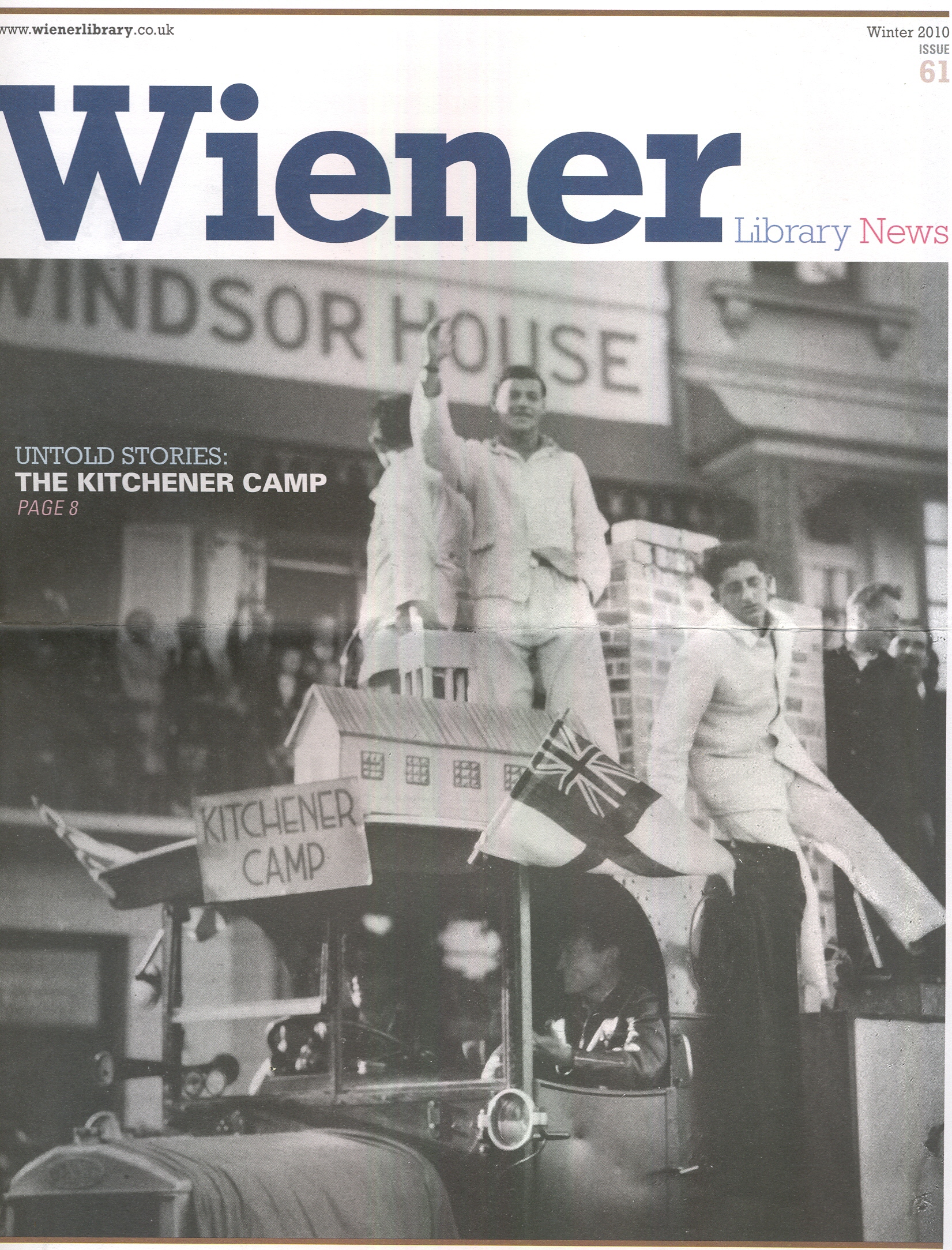


Wiener Library News, Winter 2010, Issue 61. Front cover and pages 2 and 10 (click on images to zoom in)
Significantly, in an article published in 1963 about antisemitism, the Wiener Library Bulletin did make a brief statement about Chesterton, but only to report that “no Briton, least of all a Catholic, will feel pride in the obsessions of G. K. Chesterton.”[6]
The myth that the Wiener Library defended Chesterton has been recycled in a number of books, newspapers, and periodicals as if it was established truth. Joseph Pearce reproduced Coren’s defence in his own biography of Chesterton published in 1996.[7] Aidan Mackey referred to it in a letter to the editor of the Jewish Chronicle in 1997.[8] Ian Boyd, editor of The Chesterton Review and president of the G. K. Chesterton Institute for Faith and Culture, and Stratford Caldecott, chairman of the journal Second Spring, have also referred to it in more recent statements denying Chesterton’s antisemitism.[9] William Oddie’s essay on the so-called “philosemitism” of Chesterton also cites the Wiener Library defence.[10] The resilience of this myth is demonstrated by the fact that there are still numerous internet pages that refer to it.[11]
Update (6 September 2013): In response to a request to cite his source for the statement attributed to the Weiner Library, Michael Coren stated in a twitter posting to @Barthsnotes and @OliverKamm (Oliver Kamm) on 2 September: “Conducted interview in 86, with the librarian there who spent the morning with me. 27 yrs ago. No idea of his name.” This would suggest that at best the reported views were the personal sentiments of one of the many librarians who have worked at the Wiener Library but were unauthorised to speak officially on the Library’s behalf, rather than the Wiener Library itself. It is of course impossible to verify without a name – and indeed, it may be reasonably asked why the librarian’s name was not collected and cited at the time.
Update (23 September 2013): In an online article published on 13 September, Coren stated that he discussed his research with a librarian at the Wiener Library but that he has “no name” and “no proof” as it was a quarter of a century ago. [12] This episode is discussed in “Ludicrous, surreal” defence of G. K. Chesterton“.
According to Oliver Kamm in the Jewish Chronicle (online edition, 10 October 2013; print edition, 11 October 2013), when he wrote to Coren to ask him about his statement about the Wiener Library defending Chesterton, Coren replied, “regretting that he could not recall the name of the librarian with whom he spoke and that his records from this pre-digital age had not all travelled with him to his current home in Canada.”
Notes for the resilient myth that the Wiener Library defends G. K. Chesterton from the charge of antisemitism
1. Michael Coren, “Just bad friends,” review of G. K. Chesterton, by Michael Ffinch, New Statesman, 8 August 1986, 30.
2. Michael Coren, Gilbert: The Man Who was G. K. Chesterton (London: Jonathan Cape, 1989), 209-210.
3. Email to author from Michael Annegarn, Wiener Library (approved by Ben Barkow, Director of the Wiener Library), 22 March 2010.
4. Ben Barkow, “Director’s Letter,” Wiener Library News, Winter 2010, 2.
5. Simon Mayers, “G. K. Chesterton and the Wiener Library Defence,” Wiener Library News, Winter 2010, 10.
6. “Christian Conscience on Trial,” Wiener Library Bulletin XVII, no. 4 (October 1963), 1.
7. Joseph Pearce, Wisdom and Innocence: A Life of G. K. Chesterton (London: Hodder and Stoughton, 1996), 448.
8. Aidan Mackey, “Chesterton: Case for the defence,” Jewish Chronicle, 19 December 1997, 23.
9. See Ian Boyd, “Introduction,” Chesterton Review XXXII, no. 3&4 (Winter 2006), 276; Ian Boyd, Stratford Caldecott and Aidan Mackey, “Chesterton’s alleged ‘anti-Semitism,’” http://www.secondspring.co.uk/spring/semitism11.htm (downloaded 1 May 2013).
10. William Oddie, “The Philosemitism of G. K. Chesterton,” in William Oddie, ed., The Holiness of G. K. Chesterton (Leominster: Gracewing, 2010),130.
11. For some examples, see: https://simonmayers.com/2013/10/14/wikipedia-g-k-chesterton-and-the-wiener-library-defence/
12. Michael Coren, “‘Ludicrous, surreal episode’ against G. K. Chesterton returns,” The B.C. Catholic, 13 September 2013, http://bcc.rcav.org/opinion-and-editorial/3069-canonization-attempt-resurrects-anti-semitic-claim (downloaded 17 September 2013).
 Religious Histories and Discourses