Occasional Writings
Father Arthur Day and the “Spiritual Jewess” (1943)
Nadia Valman, an expert in Victorian literature and discourses about Jews, has argued that during the Victorian period, “Jews were imagined as much in terms of desire and pity as fear and loathing. Rather than a denigrated masculinised figure, the Jewess was often, in fact, an idealised representation of femininity. And it is the image of the beautiful or spiritual Jewess, whose Judaism is not permanently inscribed on her body, that reveals most dramatically the ambiguous and dynamic character of responses to Jews in England.” Valman suggests that this image of the beautiful or spiritual Jewess has been neglected in “accounts of antisemitic discourse.” See Nadia Valman, The Jewess in Nineteenth-Century British Literary Culture (Cambridge: Cambridge University Press, 2007), page 3.
Sadly, my PhD thesis, examining antisemitic myths and stereotypes of “the Jew” in English Catholic discourses in the late nineteenth and early twentieth century, did little to rectify this particular lacuna. However, I did find one interesting example of the stereotype of the “spiritual Jewess.”
In 1943, Father Arthur Day, an English Jesuit and vice-president of the Catholic Guild of Israel (an organisation dedicated to the conversion of Jews), stated that: “The total number of Jews received by me into the Church barely amounts to twenty – a modest score! Two or three of these had received their instruction at the Convent of Our Lady of Sion. As a rule the women converts made considerable scarifies and prove a great success. Indeed, the female sex amongst the Jews seems to possess some striking features of superiority; and it has often been remarked that, in our drama and fiction, Jewesses are almost always represented as good and attractive. Our Lady must have something to do with this phenomenon. Likely enough She is at the root of it – the Root of Jesse, Rachel, Miriam, Debbora, Ruth, Judith and Esther are at least morally in the same line of descent. My men converts just form a ‘minyan’ (ten). Out of this quorum there are a couple of ‘doubtfuls,’ and four to whom full marks may be allotted. There are also, alas, three undeniable failures.” See Arthur F. Day, Our Friends the Jews; or, The Confessions of a Proselytizer (London: Burns Oates and Washbourne, 1943), page 14.
Helen Fry’s The M Room: Secret Listeners who Bugged the Nazis in WW2 (2012).
Review of Helen Fry’s The M Room: Secret Listeners who Bugged the Nazis in WW2 (2012).
In 1999, a large number of MI19 documents relating to the so-called M Rooms were released (MI19 was a branch of British Military Intelligence tasked with obtaining information from prisoners of war). As Helen Fry explains in her recently published book, the M Rooms (or microphone rooms) were part of a project instigated at the beginning of World War II. The first M Room was set up at a stately house at Cockfosters (a suburb of North London) that was requisitioned for the war effort when its owner, Sir Philip Sassoon, passed away (page 16). The M Rooms were locations from which German officers could be monitored by ‘secret listeners’. Later in the war, two additional estates were selected for the project to cope with the influx of prisoners (pages 47-48). More important than the interrogations at these stately homes were the listening devices carefully secreted throughout the buildings which allowed the conversations of prisoners of war to be listened to when they were left alone. From 1943 onwards, it was largely German refugees, many of whom were Jewish, who were tasked with listening in to these conversations. Among the prisoners were a number of high-ranking German officers, including fifty-nine Generals (page 11). Lulled by their comfortable surroundings at Trent Park, the Generals revealed a great deal of information in their not so private conversations.
Fry reveals that a great deal of useful military intelligence was gathered in the M Rooms, relating to ‘[German] rockets, flying bombs, jet propelled aircraft and submarines’, ‘German secret weapon development programme, new technology on Luftwaffe planes, Hitler’s plans for a gas attack on Britain, German battle plans, U-boat bases’, and so on (page 11). Her study is also a useful resource for historians interested in antisemitism, with extracts from the transcripts of conversations recorded in the M Rooms – according to Fry, the National Archives at Kew hold the transcripts of over 10,000 German prisoners of war held by MI19 (page 285) – as well as the recollections of Fritz Lustig. These recollections are interesting as they draw attention to the role played by German Jews in the British Army during the war. Fry draws extensively on the recollections of Fritz Lustig, ‘a German, forced to flee Hitler’s regime because the Nazis considered him a non-Aryan’ (page 10). Lustig enlisted in the British Army, and after a period working in an unskilled labour unit of the Pioneer Corps, he was recruited to become one of the many secret listeners (pages 10-11).
Fry quotes extracts from a number of recorded conversations. For example, on 10 July 1943, General Georg Neuffer was recorded asking Major-General Gerhard Bassenge (both identified as German Generals with anti-Nazi views): ‘what will they say when they find our graves in Poland? … I must say it was frightful, a horrible sight. There were lorries full of men, women and children – quite small children. … The women, the little children who were, of course, absolutely unsuspecting – frightful! Of course, I didn’t watch while they were being murdered’ (pages 197-198). Both of these Generals were again recorded on 19 December 1943 discussing the number of Jews executed in Poland, estimating figures between three and five million (page 198). Another German officer, named Kittel, confided that he had on one occasion gone up to an SS man during a public execution of Jews in Latvia and told him: ‘Once and for all, I forbid these executions outside, where people can look on. If you shoot people in the wood or somewhere where no one can see, that’s your own affair’ (pages 199-200). He found the spectacle of Jews being publically murdered distasteful and unwise, but he did not seem to regard the murders as intrinsically wrong per se.
One disturbing feature of this material, as Fry observes, is that some of the transcripts from the M Rooms could have been used as evidence against war criminals. They were not, and Fry justifiably asks: ‘why were the files withheld’ (page 252)? According to Fry, as a result, some prisoners identified in the transcripts went unindicted for war crimes admitted during their confinement by MI19 (page 259).
In conclusion, Helen Fry’s study brings together a mass of useful primary source material (a mixture of MI19 transcripts and the recollections of secret listeners and their families). My only real grumble is that the referencing could have been more thorough. In some cases document numbers are provided for files in the National Archives. But in other instances reports and recorded conversations are referred to but without a clear reference. However, whilst occasionally frustrating to those of us who would like to go to the archives to see the documents for ourselves (ideally pre-armed with a list of references), it is nevertheless an interesting and valuable study.
Paper on the Catholic Guild of Israel at the BAJS Annual Conference (7-9 July 2013)
The British Association for Jewish Studies (BAJS) Annual Conference went ahead on 7-9 July 2013 at the University of Kent, Canterbury. The theme for the BAJS conference this year was ‘Memory, Identity, and Boundaries of Jewishness’. I presented a paper at the conference which examined constructions of Judaism and Jewish identity in the discourse of members of the Catholic Guild of Israel (1917-1943).
The Catholic Guild of Israel was founded in England in December 1917 by Father Bede Jarrett with the support of the Sisters of Sion and the Arch-Confraternity of Prayer for the Conversion of Israel. This initiative received the blessings of Benedict XV and subsequently Pius XI. Whereas the Sisters of Sion and the Arch-Confraternity were content to pray for the conversion of Israel, the new Guild took a much more proactive approach to converting Jews.
One aspect of the Guild’s mission was to improve the way that English Catholics perceived Jews. However, despite the Guild’s allegedly benign intentions, the senior members were not able to master their own prejudices. Their articles and lectures frequently contained antisemitic stereotypes of the greedy stock-market and usurious Jew, and the revolutionary Bolshevik Jew. Whilst it was sometimes acknowledged that Jews had been persecuted by Christians, this was countered by caricatures of “the Jewish Mentality” and the Talmud as violently anti-Christian. It was suggested that Christian violence towards Jews was not always unprovoked. The stereotype of the smart powerful Jew was also a reoccurring theme in Guild publications, but it was part of an ambivalent narrative. The president and the vice-president of the Guild both explained that “the Jews” could be an asset if their “zeal” and “flame” could be brought into the Church. They suggested that whilst “the Jew” was “a hard nut to crack,” their “kernel was sweet,” and that they contained a reservoir of intellect and energy, which though dangerous to Christian civilisation, could be put to good use if assimilated to the Church.
Significantly, similar stereotypes of “the Jew” can also be found in the discourses of Jewish converts within the Catholic Guild of Israel. Hugh Angress, a convert from Orthodox Judaism, repeated these stereotypes, and he argued in lectures and a booklet that Catholicism is fulfilled Judaism. The most prominent convert in the Guild was Hans Herzl, the son of Theodor Herzl. Hans Herzl converted to Catholicism and joined the Guild in 1924. Though he did not remain in the Church for long, he expressed ambivalence about Zionism during this time in the pages of the Catholic press.
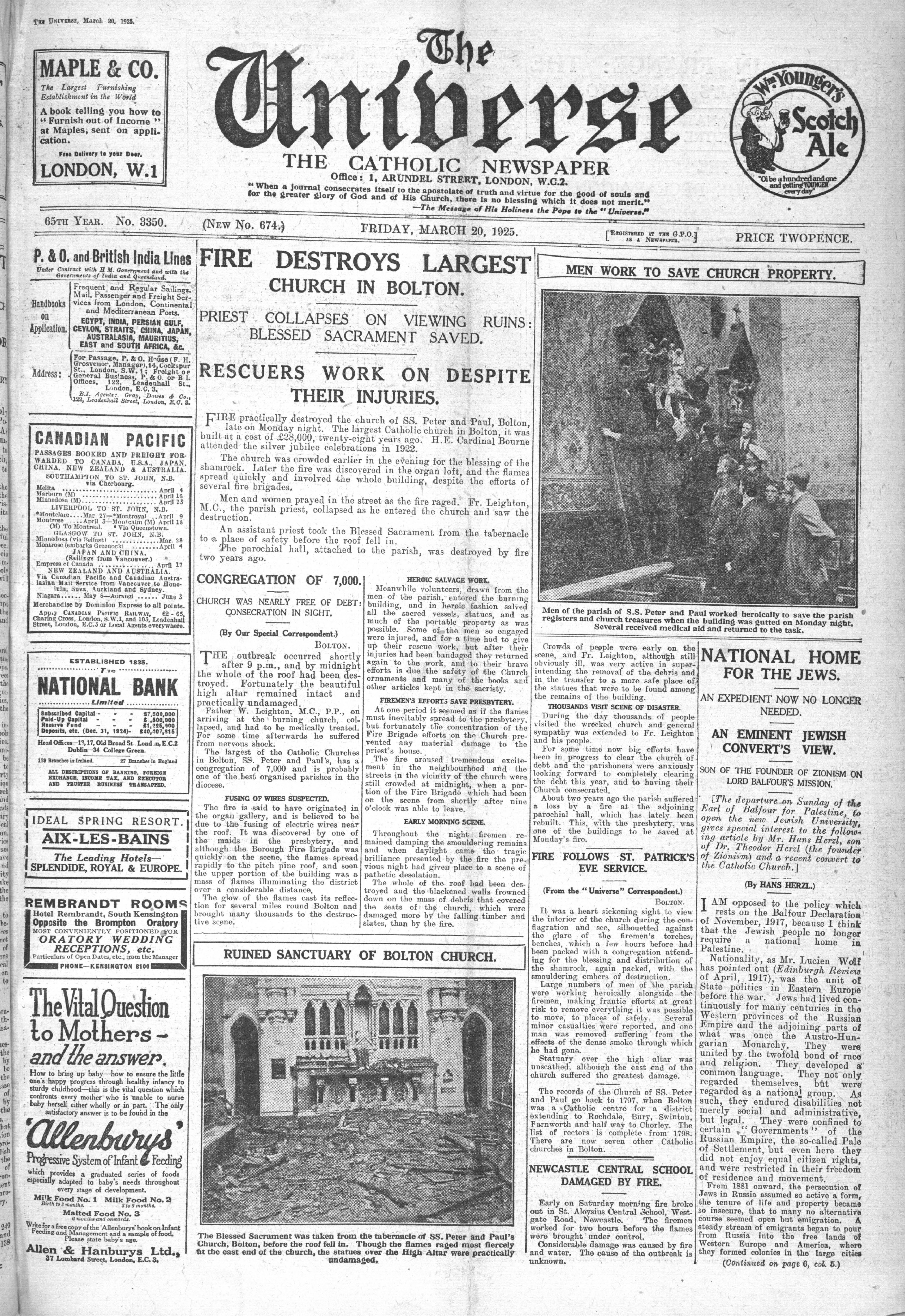

Hans Herzl discussing Zionism in The Universe (an English Catholic Newspaper), 20 March 1925.
My paper examined the images of ‘the Jew’ constructed by prominent members of the Guild, such as Father Bede Jarret (the head of the English Dominicans and the founder and president of the Guild), Father Arthur Day (an English Jesuit and vice-president of the Guild), Dudley Wright (an author and ex-Freemason), Hugh Angress (a Jewish convert) and Hans Herzl (a Jewish convert and son of Theodor Herzl).
 Religious Histories and Discourses